
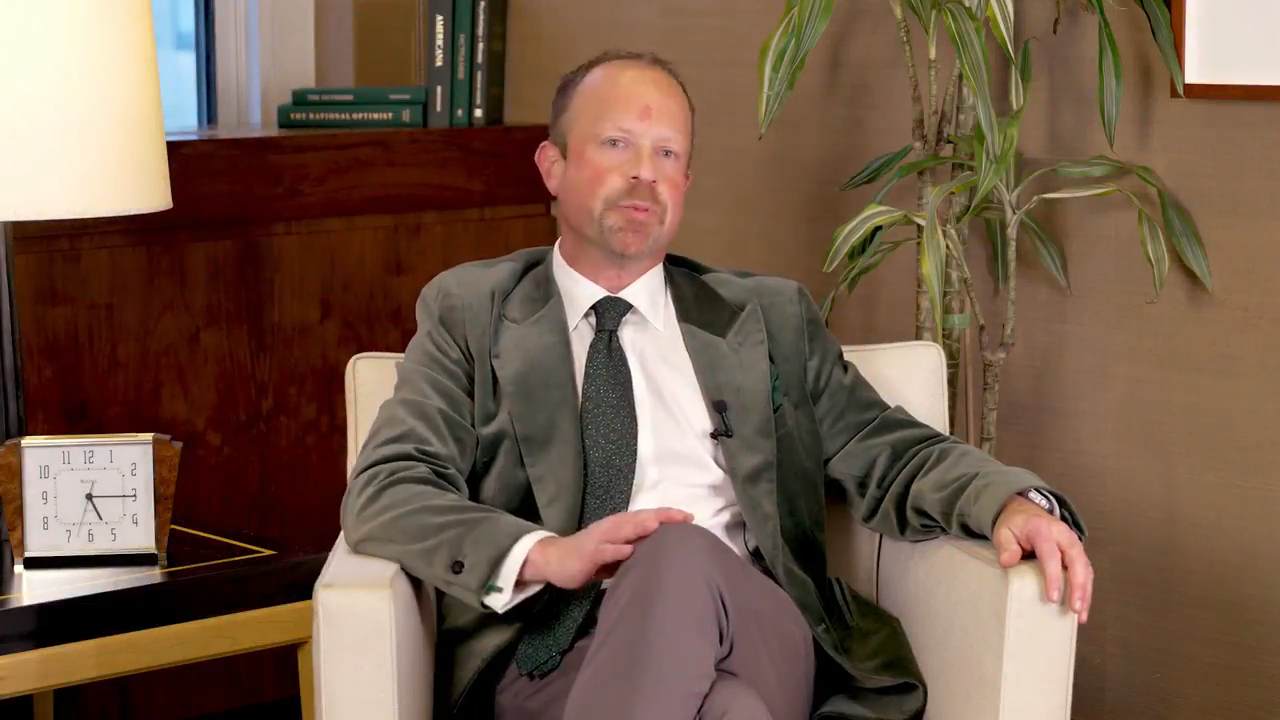
PM Chris Davis on what has helped Davis Select US Equity ETF (DUSA) become one of the top active ETFs in the industry.
Transcript
Chris Davis: I'd like to take a few minutes of your time to talk about DUSA, our actively managed large cap value ETF. What's amazing about this is you're hearing a lot about actively managed ETFs recently, and we were actually among the first actively managed ETFs launched almost ten years ago.
We just celebrated our ninth anniversary, so therefore we have our own distinct track record in managing this active ETF and it's a track record that we're proud of.
We're approaching a billion in assets under management and I want to report to you a little bit about the results and the positioning of our ETF.
So let's start with the results. DUSA has outperformed the large cap value index in all periods, not just in 2025 but in three, five, seven years, and really since we started it, over nine years ago. It's the number one performing active or passive large cap value ETF over the past three years and we're rated four stars from Morningstar.
Now one of the reasons that people are drawn to ETFs is their tax efficiency, and true to that premise, we paid no capital gains in 2025 despite these strong results.
So how have we achieved these results? Well, we've done it with the core tenets and the key attributes of our firm. It starts with an experienced team. Many of you have been invested with us for decades, and we have decades working together as a team here. That means we've been able to navigate successfully all different types of market and economic environments, booms and busts, recessions, contractions, crises, but also bubbles and manias, being able to navigate through all different types of weather together.
We do this with a highly selective and a truly active, actively managed portfolio. We're not benchmark huggers. We don't think you can achieve something different from everybody else by looking like everybody else. We're willing to go against the crowd, seeking the best opportunities across all sectors and industries. This is a true stock pickers portfolio.
We have a time-tested, what's called a relative value investment approach. That distinguishes us from what we think of as deep value or growth or some of the other categories that are out there.
But what that means is we recognize that if we want to own businesses that can compound over the long term, we have to answer two questions. What sorts of businesses do we want to own and how much do we pay for them?
The first is about a focus on quality. We're seeking durable, growing businesses that generate strong, free cash flow that have resilient balance sheets that have deep moats and competitive advantages and are run by experienced and proven leaders.
But the second question is just as important. That's the hallmark of our valuation discipline. How much do we pay? And what you see over and over is that we simply won't chase growth. We are not momentum investors. We are value investors. And that valuation discipline remains a core tenet of our approach.
And the final attribute that I think it's always important for advisors to bear in mind is this deep alignment of interests. We are among the largest shareholders in our investment strategies. Our partners, my colleagues, our families, we are invested side-by-side with your clients. And that means we remain steadfastly focused, not just on returns, but also on risk because it's our money invested alongside yours.
So, now let's look a little bit at the return drivers of the last year or so. One of the most interesting things has been that people have finally begun to see the green shoots of the financial services sector performing better after long periods of being in the wilderness. Well, we have some expertise in this area, but we are not sector investors. What I mean by that is we're focused on a highly select few financial companies that we view as competitively advantaged and that still have a long way to go.
So our financial holdings, not just outperform the S&P 500, but actually also significantly outperformed the financial services index. So that's the value of seal activity.
What's an example of that? Well, let's look at Capital One or Wells Fargo in the banking sector or Markel in the insurance sector. All big drivers of returns in the recent periods.
Now, when we look at technology where all of the spotlight has been, here we also bring to bear a highly selective approach in looking at this dynamic but risky and fast-changing sector.
So, let's focus first on what we call the picks and shovels company. This is recognizing that in the Gold Rush, sometimes, the speculation is dangerous, but the providers of services and equipment to that gold rush can be very profitable investment.
So companies like Applied Materials or Texas Instruments, they may not be the most glamorous, but they have enormous durability and resilience and really are well positioned as money and capital spending pours out of that sector.
And then within the traditional sort of tech sector, where are we seeing the biggest opportunities? Well, it's really in the companies that have durable cash flows, have huge customer bases, and have the management that has the record of being able to deploy capital wisely.
Because in this gold rush era, you don't want to get caught up in a mania, and you don't want to be beholden to the kindness of strangers and constantly having to raise capital or negotiate equity deals. So here, companies like Google, or Meta, or Amazon stand out rather than some of the hot new AI companies that we see as much more at risk of this sort of bubble mania.
Now another contributor to results in the last year was our selective and opportunistic approach to investing in healthcare. We all know that healthcare is a dynamic and growing part of GNP, but it's also a risky area because there's so many companies that can get hyped up because of a single product
That is not our approach. Instead, we look at the durable characteristics of certain healthcare service providers. So, for example, last year, a company that had been way out of favor just a few years ago was an enormous contributor to performance, CVS.
But we also own companies that are durable providers of the less glamorous sort of products that make up some of that healthcare spending companies like Solventum, for example, or Viatris.
And finally, I'd add, in terms of being opportunistic, we will tend to look at companies when they are out favor. So last year you saw us initiate a position in UnitedHealth when it was in the headlines and deeply out of favor and controversial.
So those are some of the drivers of recent returns, but that looks backwards. Let's spend a moment and make sure we look ahead.
And the most important data I can share with you, if you want to understand our optimism and conviction and confidence about the future, it's really captured in this. It's that by being highly selective, only owning 25 to 30 companies, we've been able to build a portfolio of companies that combined the best of both worlds. What we used to call a value investor's dream. Companies that have generated durable growth but yet are also trading at a steep discount to the averages.
And while I talk about the growth and the valuation, remember, we're not just comparing them here to the value indices, but even to the market as a whole.
That is what gives us conviction that in a sense, the past can be prolonged, that we're positioned both to be resilient, but over time to generate results that we think can be attractive relative to the indexes on both an absolute and a relative basis.
More Videos
What Drives Stock Selection in the Davis ETFs’ Active Strategies (1:31)

Why look around the world for investment opportunities?